


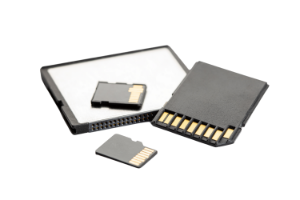
We Transfer Files From All Types of Memory Cards and SD Cards
SD, SDHC, SDXC, SDUC, UHS-I, UHS-II
MICROSD (TF), MICROSDXC, MICRO SDHC, MINISD, MINISDHC
XD PICTURE CARD, MMC, RS-MMC
SMARTMEDIA CARD (SM), MICRODRIVE
COMPACTFLASH (CF), CFEXPRESS TYPE A, B, XQD
MEMORY STICK (MS), M2, MS DUO, MS MICRO, MS PRO, MS PRO DUO,
MS XC, RS-MMC, MS PRO HG, MS PRO HG DUO, MAGICGATE MS, MS MICRO
Don’t let your precious photos and videos become trapped on old memory cards from past cameras and phones. So many of us have a drawer full of various SD cards, MicroSD cards, and other formats. These small cards are easy to lose, can degrade over time, and are not easily read with today’s common devices, putting your irreplaceable memories at risk.
Rather than buy a card reader for each type of card from over the years, simply bring us your collection and we will carefully transfer photos from sd card to flash drive or another modern storage device of your choice. Our service makes it easy to move from SD card to USB or SD card to USB-C, consolidating all your files in one organized place. We also verify all files successfully transfer, and offer troubleshooting and recovery options.
Once we move all of your photos and videos off your memory cards and SD cards to a new USB drive, you’ll have a world of options for easy viewing, sharing, uploading, reprinting, editing and archiving. Stop by any location to get started!
Move Files off Memory Cards & SD Cards to USB with Memories to Digital
Read & copy dozens of card formats
Data transfer integrity checks
Troubleshooting & repair options
Why buy multiple, specialized readers you’ll use only once to read obsolete cards? At Memories to Digital, we read dozens of memory card formats, from modern SDXC to old SmartMedia. And unlike a simple card reader, we verify file transfers and offer troubleshooting options for unreadable cards. We save you the hassle while providing a more secure, organized, and complete transfer of your memories to a modern USB drive (or two if you want a backup!).
Additional Information
What’s Included When We Transfer From Memory Cards and SD Cards to Flash Drive
All memory card data transfers include:
- Meeting with you to discuss the details of your project. If you’ve mailed your material, we’ll call you for details.
- Transferring your files to a new storage medium. This process includes:
- Reading and exploring each original storage medium you provide.
- Copying the data to your new storage medium.
- Creating a folder system on the new storage medium to account for and organize the data from each original source.
- Checking the integrity of the data transfers to verify that all files copied completely.
- Documenting any hardware, software or file system problems that prevent a complete data transfer.
- Advising you as to any troubleshooting or repair options.
Your original storage media are returned to you with your finished project. All data migration is done by our professionally trained staff in our local lab.
Note: Data transfer is limited by the condition of your original media. Additional charges may apply for: cleaning, handling, troubleshooting, or repairing dirty, moldy, damaged, degraded, corrupted or otherwise untransferrable media or files ($120/hour, $19.95 minimum per media, $4.95/file). Drives sold separately.
Preparing Your Memory Cards for Transfer
- Number each original storage medium if there is a specific order you’d like us to maintain.
- Think about how many copies you’ll need. We recommend purchasing a second copy that can be stored separately for safekeeping.
- Consider subscribing to our local, secure, offline backup storage plan.
- Once your memories are backed up and easily accessible, read about all of the services we provide to help you edit and share your digital video and your digital photos.
- Get started – pick a location to drop off your media and book an appointment, or simply stop by a location that accepts walk-ins.
-
Memory Card and SD Card to USB File Transfer Pricing
Storage Medium | Pricing |
Memory Cards | $14.95/drive up to 32GB $29.95/drive up to 64GB $59.95/drive up to 128GB $99.95/drive up to 256GB Over 256GB $99.95/250GB |
Minimum order: $29.95
Additional charges may apply for: cleaning, handling, troubleshooting, or repairing dirty, moldy, damaged, degraded, corrupted or otherwise untransferrable media or files ($120/hour, $19.95 minimum per media, $4.95/file). Drives sold separately.
Why Choose Memories to Digital?
We Treat Your Memories as if They’re Our Own
We founded Memories to Digital in 2003 after our family mailed their family films away and they got lost. We wanted our community to have a local place to convert family memories, one that offered an alternative to faceless mail-away services.
Today, whether you visit a Memories to Digital location, a Memorywise location, or one of our local partner businesses to drop off or pick up, you receive the same great service from the same dedicated local team. We are your media digitization experts.
We do 100% of our work ourselves, in-house, locally. We give you and your memories the personal service, care and attention deserved, and we use the latest technology to provide you with high-quality digital memories.
Safe, Secure, and Nearby
Eliminate the worry of mailing your memories. We’re local, we do all of our work in-house, and we take it seriously to safeguard your media while in our care.
Media Digitization Experts
Put our extensive digitization expertise to work! We don’t sell cameras or print photos–we specialize in converting all of the old media formats into the latest and best digital formats.
Quality You Can Trust
Our 30-day, 100% guarantee says it all. We pride ourselves on delivering the best possible digital replication of your media as ordered, and will work tirelessly to resolve any issues.
Customized Solutions
Meet with a real person and get your project done right. We’re not a cookie-cutter, drop-box operation– we offer a level of personal service and customization others can’t touch.
Testimonials
Just wanted to thank you again for the great job you did on my family’s movies. They were a big hit, especially the first DVD – The Early Years. Mom and Dad both teared up as they told their children and grandchildren about our family’s history.
Oke Johnson
Superior, CO
Thank you – the film transfers look terrific! It cost a little more than I had imagined, but it was well worth it. You did a great job and be sure that I will recommend your work anytime. I already did my first DVD with some of the clips and it just looks great!
Niwot, Colorado
Our Process

1. Contact & Drop Off
When you’re ready to get started, pick a location to drop off your media and book an appointment, or simply stop by a location that accepts walk-ins. During your initial appointment, we will gather the details, determine which services best suit your needs, and provide an estimate of cost and timing. If your appointment is via phone, we will make arrangements for you to drop off your media.

2. We Digitize!

3. Enjoy, Share & Preserve
Common Questions
Question goes right here
Your content goes here. Edit or remove this text inline or in the module Content settings. You can also style every aspect of this content in the module Design settings and even apply custom CSS to this text in the module Advanced settings.
Question goes right here
Your content goes here. Edit or remove this text inline or in the module Content settings. You can also style every aspect of this content in the module Design settings and even apply custom CSS to this text in the module Advanced settings.
Question goes right here
Your content goes here. Edit or remove this text inline or in the module Content settings. You can also style every aspect of this content in the module Design settings and even apply custom CSS to this text in the module Advanced settings.
Question goes right here
Your content goes here. Edit or remove this text inline or in the module Content settings. You can also style every aspect of this content in the module Design settings and even apply custom CSS to this text in the module Advanced settings.
Preserve Your Photos and Videos with Expert Memory Card Transfers
Your photos and videos deserve to be accessible and safe, not trapped on a variety of forgotten memory cards. Our professional service is the easiest way to transfer photos from sd card to flash drive, rescuing precious files from every format imaginable. Forget trying to find a specific SD card reader, micro sd card reader, or the right sd card usb adapter for each card. We perform expert SD card to USB and SD card to USB-C transfers for a comprehensive range of media.
We handle all modern and legacy formats, including the full family of SD cards (SD, SDHC, SDXC, SDUC, UHS-I, UHS-II) and their smaller counterparts such as MICROSD (TF), MICROSDXC, MICRO SDHC, MINISD, and MINISDHC. Our lab is also equipped to read older formats like the XD PICTURE CARD, SMARTMEDIA CARD (SM), MICRODRIVE, MMC, and RS-MMC. For professional photographers, we safely transfer data from COMPACTFLASH (CF), CFEXPRESS TYPE A & B, and XQD cards. We also support the entire Sony family, from the original MEMORY STICK (MS) to all its variants including M2, MS DUO, MS PRO, MS PRO DUO, MS XC, and MS MICRO.
Our process ensures your memories are handled with care. Every transfer is handled locally by our trained staff in our secure labs in the Denver Metro and Boulder areas. Don’t risk losing your memories—visit us today to get your files moved to a safe, modern format.
Contact Us Today!
Questions? We’re Here to Help! Fill out the form, give us a call or stop by a location near you.
By providing your phone number and submitting the form, you agree to receive Customer Care related texts via SMS from Memories to Digital and MemoryWise. Message frequency may vary. Standard Message and Data Rates may apply. Reply STOP to opt out. Reply HELP for help. Consent is not a condition of purchase. Privacy policy: Your mobile information will not be sold or shared with third parties for promotional or marketing purposes. See more here.